Coming Out by Not Coming Out
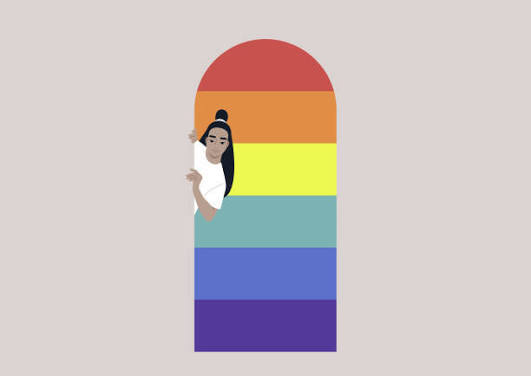
None of my friends believed me when I told them that I never want to get married. Maybe I should have clarified that I never want to get married to a man.
Oh, wait. I can't tell them that.
I live in a country where loving someone of the same gender is criminalised.
Here, same-sex marriage is illegal. Beyond the law, queer people face horrific discrimination and prosecution simply for existing. I've seen the community experience it all: the threat of imprisonment, the fear of violence, the heavy fines, and the constant shadow of being taken away from our families.
For decades, our media has been told to erase us. If we do appear on screen or in stories, it's only under one condition: we must "repent or die." There is no happy ending for people like me in the stories our country tells. Whether that is a step forward or backward, I've never quite figured out. All I know is that the silence is deafening.
Recently, I find myself seeking out stories online that are banned here. No advertisements, no reviews, not even a single word of acknowledgment in the mainstream.
You heard me right: not a single word.
- Not a single word about girls having crushes on other girls.
- Not a single word about dreaming of a future with a partner of the same gender.
- Not a single word about choosing a different family structure.
And not a single word about how unfair this all is.
I used to think that my country's denial of who I am was a way of protecting me from something "strange" or "unnatural." Now, as a young adult, I know the truth: it's just a way of silencing me. It's a system designed to oppress who I am.
And I won't allow that – not ever.
The Internet Saved Me
When the world locked down during the pandemic, I gained access to the internet like never before. Up until then, I had no idea people like me existed. I had no idea I was allowed a future where I could fall in love with a princess instead of Prince Charming.
My parents always knew something was different. I never fawned over the "cute" boys my mother subtly pointed out. My favourite characters were always female. I was different. I was eccentric. I was gay.
The internet introduced me to a community that was warm, accepting, and powerful. It was also where I first learned the term "coming out."
Redefining Validity
If you told past me that I would be okay with being into girls and admitting it to people – albeit selectively – I would've laughed in your face.
Society paints coming out as a huge ceremony where you embrace your identity openly. But I have to ask: Is coming out the only way to be valid? Is it really necessary for everyone, especially for queers living in conservative countries where coming out isn't a relief, but a red flag pinned to your forehead screaming, "Hey, I'm different! Please hurt me!"?
I never liked the idea of having to come out; I thought of it as a product of heteronormativity. After all, no one goes around coming out as cisgender and heterosexual, do they?
With that in mind, I began planning my biggest act of rebellion against a homophobic society: to come out by not coming out.
My Quiet Rebellion
It started with minuscule changes. Symbols small enough to be hidden from the untrained eye, yet loud enough for those who know.
- I changed my profile pictures to subtle colours that meant everything to me. (Feedback: "Looks like a random choice." No big deal.)
- Rainbows started appearing everywhere: muted rainbows on my wallpaper, monochrome patterns on my clothes, hidden symbols in my accessories.
- I happily rebelled by plastering my life with these forbidden symbols, bringing my truth with me everywhere, even if no one else understood.
And then, I took a leap of faith: I started writing.
I created an online space where I could publicly identify as who I am, under a name that kept me safe. I used it to advocate for others, to call out hate, and to shove (metaphorical) rainbows in people's faces.
I never had the luxury to officially come out to the people who matter most in person. Instead, I deflect when relatives hint at my future white wedding. I friendzone peers who seem too interested. I read queer stories clandestinely on my phone.
I could only be my true self behind a screen – a concealed identity.
And yet, I feel satisfied. I'm proud.
Staying in the Closet is Also Brave
I don't need to go around declaring who I am in person to feel valid. Staying in the closet to survive is a choice. Stepping one foot out into the digital world is just as brave as marching in a parade in a free country.
Of course, someday I'd love to stand up in front of a crowd and introduce myself openly. One day, I hope to wake up to a world where I can marry the person I love and live my happily ever after. I want to see pride flags in our classrooms. I want the word "gay" to no longer be a taboo.
I can only hope. But for now, when I get those "Are you gay?" questions from oblivious people, I find that "It's none of your business" is just as effective as "Yes, I am."
To anyone reading this who is hiding their truth to stay safe: You are valid. Your survival is resistance. Your quiet pride is enough.
Luah di sini: Have you ever had to hide parts of your identity to stay safe? How do you find your own version of freedom? Share your story anonymously.